 |
||||||||
 |
 |
|
||||||
 Available russian version Available russian version |
 |
 |
|

Issues of 2008
|
|
Museum at the Bottom of the Gulf of Finland
Being a part of the Baltic Sea, the Gulf of Finland was always an important and highly traveled trade route, especially for the Hanse merchant ships. It is difficult to navigate in the Baltic Sea. Autumn storms, numerous shallows and intricate fairways make it dangerous to travel across the Baltic. Sailors of different countries have paid large contribution to the sea deity. Pirates often hunted merchants and scuttled their ships. At wartimes, dozens of ships were scuttled during fierce sea battles as well. Many divers and treasure seekers spend all their time searching for drowned riches that rest at the bottom of the Baltic Sea. Let us name the most interesting and important shipwrecks that took place there in the recent past. A battleship "Narva" floated out in 1914 exploded in summer 1715 and instantly sank at the main Kronstadt roadstead. According to some researchers, lightning struck the ship▓s powder room, but that fact is not confirmed documentarily. The nose of the battleship was completely destroyed while the rest of the ship sank. However, three cannons and some goods were retrieved soon after the accident during the reign of the Emperor Peter I. In 1719, two more battleships of the Baltic fleet suffered shipwreck near Kronstadt: 58-cannoned battleship "London" and 54-cannoned "Portsmouth" (both battleships had been purchased from abroad). Normally, about 10√12 ships sank each year at those times. Sometimes the number of drowned vessels reached twenty-five per year. "London", "Portsmouth" and "Devonshire" sailed to Kronstadt. There were no pilots on board the ships, and as a result, they ran aground. Devonshire managed to get afloat while the other two ships remained at the shallow, which was later named "London shelf". Nowadays the battleships are buried with sand: thus, it may happen that they are preserved in rather good condition. 66-cannoned ship "Vysheslav" returning to Kronstadt after the Esel battle sank in 1789 near the island of Gogland. Though the crew suffered no casualties, all goods, weapons, ship items and personal belongings were lost. In summer 1790 at the height of the Russian-Swedish war (1788√1790), the Swedes were locked in the Vyborg Gulf. The Russian fleet blocked the entrance to the Gulf from the Baltic Sea, while minor rowboats barred skerry waterways. Thus, the Russians intended to hold the Swedes in the trap until their food and water supplies gave out. In June, a steady wind blew from the sea offering the Swedes no chances to escape. On July 2, the wind suddenly worked round and the Swedes started to prepare a breakthrough operation. A battleship "Dristigheten" commanded by colonel Johan af Pukke was the first to face Russian ships. The Swedish King Gustav III instructed him: "You are leading my fleet. Do not spare yourself. I won▓t forget your efforts!". The captain replied like an old sea dog: "Your Majesty, as for me, I will do my best, God damn it. But I can say nothing about others". Well, others largely failed┘
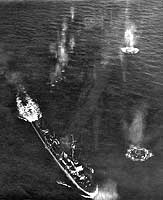
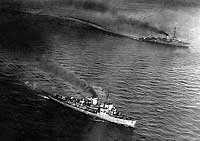
On July 3 at 6 a.m., the Swedes started the breakthrough battle. Rowboats followed the larger ships. "Dristigheten" was attacked first, but managed to escape with a part of the fleet to Sveaborg. Others were less lucky. One of the Swedish fire ships "Postilionen" (a minor vessel-kamikaze specially meant for ramming and burning of the enemy▓s warships) towed by a battleship "Enigheten" suddenly exploded. According to eyewitnesses, the captain of the fire ship drank slightly more than it was needed to face the enemy and make a correct decision. That is why instead of a Russian ship "Saint Peter" the burning fire ship ran into "Enigheten". Soon both ships exploded and sank down. Russian ships continued destroying the Swedish fleet. As a result seven Swedish battleships, three frigates and several dozens of boats were sent down to the bottom of the Gulf of Finland. Some of the ships were cast ashore. On September 23, a squadron of three battleships and an 84-cannoned battleship "Lefort" under the command of Rear Admiral Nordmann left Revel (Tallinn) and headed for Kronstadt. Alongside the crew, there were several dozens of military officers with their families on board the ship. They planned to spend winter in St. Petersburg. At night, the wind got up and it started to snow. By 5 a.m. the squadron passed the island Bolshoi Tuters. The ships sailed on the starboard tack and at 7 a.m. started gybing on the port tack. During gybing "Lefort" (which was the second in the formation) heeled on the port side. The ship began to sink. Passengers and the crew stampeded to the starboard. At 7.23 a.m., "Lefort" rapidly went down. There were no survivors. No one knows exactly why and how it happened, as the wind was not strong enough to keel over the ship. Supposedly, due to considerable lurch, the fasteners of cannons broke and they increased the heel. The heavy cannons could even break the ship▓s board. As the ship sailed without ballast, its stability was lower than usual. According to a special investigating committee, the battleship sank because of improper exploitation of artillery decks earlier in 1856 (that year the ship was used as a cargo ship for transportation of heavy loads two times). However, most likely there were several reasons of the tragedy. The water came into the holds of the ship and increased the heeling. Reportedly, in 1893 an armour-clad boat "Rusalka" ("Mermaid") heading to Helsingfors (Helsinki) from Revel sank in similar circumstances (because of loosely battened hatches). Eight hundred and forty three men and women died at "Lefort". The catastrophe stunned the Russian Empire. Shocked by the tragedy, a renowned Russian artist created a painting "Wreck of ⌠Lefort■". In 1864, armoured plates for first "Hurricane" ships were taken from England to St. Petersburg. At the main Kronstadt roadstead, a sudden blast of wind heeled the cargo ship that transported armoured plates, and one of the plates fell overboard. The captain managed to mark the place. Of course, at that time nobody thought about retrieving of the armoured plate weighing dozens of tons from the bottom of the sea. Nowadays this is not an easy job as well. Still, it may happen that one day that plate will be displayed at a navy museum. Of course, not only ships and boats lie at the bottom of the Gulf of Finland. Other "exhibits" include numerous airplanes knocked down during World War II. German and Finnish bombers and fighters flew across the Gulf of Finland on their way to Leningrad and Kronstadt. Soviet anti-aircraft defense was good enough to resist the majority of attacks of the Luftwaffe. Anti-aircraft batteries and observation and signal posts were located along the coast of the Gulf, in Kronstadt and on island forts. First radar devices "Redut" ("Redoubt") were placed on the southern coast of the Gulf of Finland in autumn 1941. Anti-aircraft guns often managed to knock down German and Finnish bombers during air raids, and the latter fell into the waters of the Gulf. Observation and signals stations recorded the number and approximate location of the knocked airplanes (though it was hard to specify exact coordinates of each plane). There are a great number of "Heinkel", "Junkers" and "Fokker" airplanes at the bottom of the Baltic Sea. However, one may also find rare and unique planes like American "Bruster" planes purchased by Finnish Air Forces just before the beginning of the war. Soviet planes were knocked down as well: PE-2, IL-2, DB-3, LA-5 and others. Survived pilots prepared detailed reports and plans of air battles with approximate coordinates of the knocked planes. Since summer 1942, Soviet air attacks on German and Finnish transport ships became more effective. In 1943, Soviet strike-fighters were equipped with American air photo cameras. Soviet pilots were obliged to photograph sunken ships and to mark location of destroyed vessels on special maps. The author of the this article tried to compare that maps with indicated coordinates with the present day maps of the Gulf of Finland in order to find the exact place of some of the vessels. Unfortunately, the author discovered some curious mistakes: according to the wartime maps, a number of German ships found themselves on islands of the Vyborg Gulf. Information presented by pilots of torpedo-bombers ≈ the so-called "free chasers" ≈ is even less reliable. According to their reports, they destroyed an enemy ship in each mission. All this data needs to be checked on very carefully. Among vehicles lying at the bottom of the Gulf of Finland are tanks and various automobiles. However, it is not an easy task to organize search parties or to lift the drowned objects to the surface. Under the present legislation, one has to get permission from several state institutions including the Institute of History of Material Culture (IHMC). The author of the article entirely approves of this precaution, as the procedure of retrieving sunken vehicles demands careful attitude and long and elaborate preparations. Unfortunately, alongside the so-called "black searchers" (groups that illegally search for the wartime ammunition and weapons in the woods and swamps of the North-Western Russia) there are "black divers". Such people imagine themselves treasure hunters, and explore the bottom of the Vyborg Gulf in search for a Swedish ship with a load of gold coins. Alas, the permission from the IHMC is not enough in that case. One will have to settle the question with frontier guards of the Leningrad military district. The majority of objects, especially wooden ones, being drawn from under the water require immediate conservation. However, preservative agents are not cheap, while some "explorers" and "searchers" do not care about the future fate of retrieved vessels and vehicles. In the late 1860s, the Swedish government passed a law protecting the sunken wrecks, which were more than one hundred years old like monuments on land. Peter I believed that one should not salve sunken ships unless they hinder navigation. Otherwise, it reminded desecration of graves. However, sometimes researchers have to go into the whys and wherefores of a ship▓s destruction. In 1930s, the main Soviet expert in the problems of underwater archeology R. Orbeli paid much attention to that question. The new era in underwater exploration began in 1942 after invention of self-contained underwater breathing apparatus (Jacques-Yves Cousteau and Emil Ganian). Unfortunately, nowadays, Russian underwater explorers are behind the age. A. Smirnov, the author of the book "Tales of sunken ships. Swedish history at the bottom of the sea" commented the attempts of the national divers to reconstruct the Vyborg sea battle: "We badly need modern equipment and powerful pumps in order to organize well-prepared excavation works at the sites of sea battles. Zero visibility at the bottom of the Vyborg Gulf and lack of professional archeologists and proper financial backing make the situation even more complicated". It is obvious that we should establish a kind of state museum-reserve in order to preserve the unique collection of old ships at the bottom of the Gulf of Finland.
|
|
Strategic partner
Project of company 
|
|

 Headquarters, Edition, Advertising department, Sale department, Information agency
 |
|
|
|