 |
||||||||
 |
 |
|
||||||
 Available russian version Available russian version |
 |
 |
|

Issues of 2008
|
|
The time of Faberge
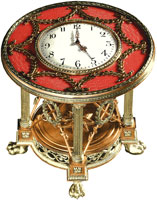
Table clocks were also produced before Faberge, but only Russian court jeweler made the performance of the table clocks the aesthetic perfection with unrivalled diversity. It was like that with all kinds of objects that were produced by Faberge. The first mentions of Faberge▓s clocks date of the beginning of the 1890s, the last ones ≈ of 1917. During that period of time the company produced about 2000√2300 table clocks. Clock-Easter Eggs and big mantelpiece clocks as "Silver group of 25 cupids" produced for the silver wedding of the emperor in 1891 (sold in 1996 at Christie▓s in New-York at the record price of GBP1,650,000) are not comprised. In the museums of Russia there are not more than a dozen of Faberge▓s table clocks (three in the Armory Museum, three in the Historic Museum, two in Pavlovsk, one in the State Hermitage museum and one in Tsarskoje Selo), in the world there are known about 500 of them. The clock is necessary for everybody: for the tsar and Bolshevik, it doesn▓t bear political meaning, that▓s why the clocks were kept safe under the Soviet power. But the clocks are first of all functional objects. They worked and stopped working. In Russia it was difficult to repair them, that▓s why many clocks disappeared. The table clocks that came to the West through London department of Faberge▓s company as cabinet gifts and that were exported by the emigrants (very few of them) can be rarely come across at the antiquarian markets. Many of them are stored in the museums. Out of 81 items sold through London department, during the last 30 years only 17 clocks went through Christie▓s and Sotheby▓s. A total of more than 200 Faberge▓s clocks is present in the catalogues of these auction houses. More than 10 "London" clocks can be found in the catalogues of the exhibitions and monographs. But still we have found only 27 "London" clocks or 32% of all the sales through the London store of Faberge▓s Company.
In the work album of the workshop of Henrik Wigstrom found in 1990 there are 62 drawings of table clocks during the period of time 1911√1916. Not more than 20% out of them are attributed. We take account of more than 400 clocks with inventory numbers of the company. These clocks were produced in the following years and percentage. The period from 1890√1898 ≈ 19%, period of 1899√1907 ≈ 37%, period from 1908√1916 ≈ 45%. Thus, there was continual growth of production of the clocks. The closing of the company in the beginning of the 1918 broke the continuity. The mainspring of Faberge-Moser was broken. The time of Faberge▓s creative life was over, the epoch of the antiquarian auctions started. In order to reestablish justice we should notice that after the beginning of the World War all the clock mechanisms were claimed to be strategic goods and the sources of the entrances from Switzerland were cut off. The analysis of the artistic values of the clocks is not our subject. We should notice only extraordinary diversity of creative approaches from the points of view of composition, shape, colour specter and used materials.
The mechanism of the clock was always supplied by Moser Company in Switzerland. These are the first-class clocks on rubies with a week▓s winding. The mechanism cost 40√50 rubles. The cost of Faberge▓s clock varied within 150√1000 rubles, but more often it cost 200√300 rubles. The salary of the jeweler in Moscow was 40 rubles, in St. Petersburg 50 rubles. About 30% of all the clocks were produced in the workshop of Michael Perchin. Faberge▓s clock is considered to be the desired object for collecting and antiquarian sale. Antiquarian potential of the group "Clock" is relatively high. We estimate it of 100 million dollars, with the average cost of GBP100,000 for 1000 clocks that can be still involved into the antiquarian turnover. 100 million dollars is a very considerable sum. Two years ago it was the summed yearly turnover of Christie▓s and Sotheby▓s sales.
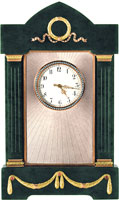
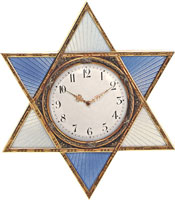
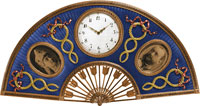
Having learned of fantastic prices many owners try to use the opportune moment and many Faberge▓s clocks of rather simple shapes and more often the most wide-spread rectangular ones appear at the market. The most expensive clocks are fan-shaped, but clocks shaped as a six-end star are even more rare and expensive. The last sales in the end of 2005 gave record results. The clock of enamel yellow and red shaped as a six-end Bethlehem star, with the estimate of GBP200,000√250,000 were sold for GBP926,400 (GBP1,603,000). The same clock was sold in Geneva in 1998 for the record sum of GBP339,000. Then the price caused the bewilderment among the Sotheby▓s clients, and now the fabulous prices are not able to surprise anyone. About 5% of the clocks are of triangular "Masonic" shape. They are the most demanded ones. The factors that accelerate the price are historic belonging (provenance) of the clock and, naturally, material-technologic characteristics. The clock that is decorated with semi-pearls on the rim of the face has higher price. Of course, the stones, precious and semi-precious ones add to the cost. Rare clocks with miniature portraits and enamel paintings ("View over Neva" and others) are also highly estimated. But such objects could decorate only the desks of the monarchs. There are plain clocks almost without any decorations, but they impress with their elegance. These are parallelepiped-clocks of lapis-lazuli, rhodonite, nephrite, bowenite and purpurin. Such "devices of time" are the dream of every antiquarian and collector.
|
|

Strategic partner
Project of company 
|
|

 Headquarters, Edition, Advertising department, Sale department, Information agency
 |
|
|
|